 Reviews


 Proudly American


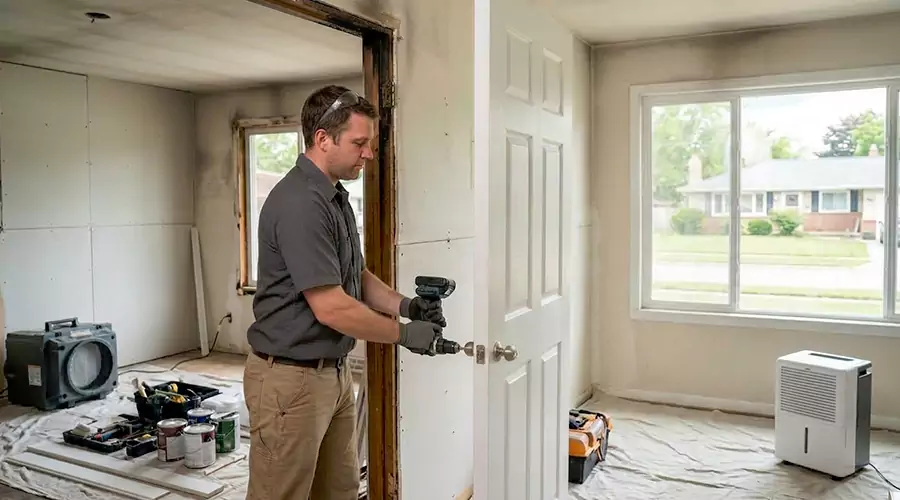
Materials should generally be replaced after a house fire when they are charred, structurally weakened, deeply smoke-contaminated, or too saturated with firefighting water to dry safely. Drywall and insulation are common replacement candidates. Structural wood may remain when it retains adequate strength and can be properly cleaned as part of fire water mold restoration.
The decision should be based on the condition of each material rather than replacing everything automatically. Some surfaces can be cleaned while others cannot be restored reliably.
Which Materials Are Most Often Replaced?
Porous building materials are more likely to require replacement because smoke odor and water can penetrate beneath the surface. Direct heat damage makes replacement even more likely.
Common replacement candidates include:
- Charred drywall
- Saturated insulation
- Burned carpet
- Damaged carpet padding
- Melted vinyl flooring
- Severely warped cabinets
- Heat-damaged electrical components
- Burned structural members
Residential fire damage restoration often combines selective removal with cleaning of materials that remain usable.
When Should Drywall Be Replaced?
Drywall should be replaced when heat has charred the paper or when saturation has weakened the board. Persistent odor after proper cleaning can also indicate deeper contamination.
| Drywall Condition | Likely Decision |
|---|---|
| Light surface soot | Often cleanable |
| Firm drywall with staining | Clean and reassess |
| Deep smoke odor | Evaluate further |
| Soft water-damaged panel | Replace |
| Sagging ceiling drywall | Replace |
| Charred paper facing | Replace |
Smoke damage from fire does not automatically mean every wall panel must come out. Surface residue can often be cleaned when the board remains dry and sound.
Should Insulation Be Replaced After a Fire?
Insulation often needs replacement when it becomes wet or heavily smoke-contaminated. Fibrous insulation can hold soot or odor in areas that are difficult to clean.
Insulation should receive closer evaluation when:
- Firefighting water soaked it.
- Heavy soot entered the cavity.
- Strong odor remains.
- The material became compressed.
- Mold began developing.
- The insulation was exposed to direct heat.
New insulation should not be installed until the surrounding cavity is clean and dry.
Should Carpet and Padding Be Replaced?
Carpet may sometimes survive light smoke exposure when it can be cleaned fully. Padding is harder to restore after saturation because moisture or odor can remain underneath the visible carpet.
Replacement becomes more likely when:
- Firefighting water soaked the padding.
- Burn marks are present.
- Smoke odor remains after cleaning.
- Melted fibers are visible.
- Contaminated water reached the carpet.
Fire and smoke damage clean up can sometimes save carpet in rooms far from the flames when residue is light.
Can Hardwood Floors Be Saved?
Hardwood can often remain when it was not burned and drying begins promptly. Smoke residue can usually be cleaned from a sound finish. Water exposure may cause temporary cupping that needs time to stabilize.
Replacement becomes more practical when boards are:
- Charred
- Split by heat
- Severely buckled
- Soft from prolonged moisture
- Detached from a damaged subfloor
Do not sand hardwood while it still contains excess moisture.
Does Burned Framing Always Need Replacement?
No. Structural wood should not be judged by color alone because superficial charring and deep structural damage are different conditions. Framing that has lost significant cross-section or strength may need repair or replacement.
| Framing Condition | Typical Direction |
|---|---|
| Surface smoke residue | Clean |
| Light superficial char | Evaluate |
| Deep charring | Repair or replace |
| Split structural member | Repair or replace |
| Significant section loss | Structural replacement likely |
Fire damage reconstruction should follow structural evaluation when framing is involved.
What About Cabinets and Built-In Furniture?
Cabinets can sometimes be cleaned if smoke affects only the finish. Replacement becomes more likely when cabinet boxes are burned or swollen by firefighting water. Particleboard components are especially sensitive to water because they can swell permanently.
Check for:
- Warped cabinet doors
- Swollen lower panels
- Loose veneer
- Charred interiors
- Persistent smoke odor
- Damaged hinges
- Weak cabinet boxes
A cabinet that looks acceptable from the front may have smoke residue inside enclosed spaces.
What Electrical Materials May Need Replacement?
Heat can damage wiring insulation or electrical devices even when the exterior appears normal. Water used during firefighting can create another concern. Electrical components that received direct fire or water exposure should be evaluated before being reused.
Potentially affected items include:
- Outlets
- Switches
- Breakers
- Wiring
- Light fixtures
- Appliances
Do not test damaged electrical devices simply to see whether they still operate.
How Can You Tell What Is Salvageable?
The main questions are whether the material remains physically sound and whether contamination can be removed.
Use this comparison:
| Condition | Clean or Repair | Replace |
|---|---|---|
| Surface soot only | Often | Not usually |
| Light odor after cleaning | Often | Not usually |
| Deep charring | Rarely | Usually |
| Severe water swelling | Rarely | Usually |
| Structural weakness | No | Usually |
| Persistent contamination | Sometimes | Often |
Fire damage removal should focus on materials that cannot safely remain rather than automatic demolition of unaffected areas.
What Can You Safely Check Yourself?
You can perform a visual check without disturbing structural materials.
Look for:
- Charred surfaces
- Soft drywall
- Swollen flooring
- Persistent smoke odor
- Sagging ceilings
- Melted plastic components
- Loose cabinets
- Water-damaged trim
Photograph questionable materials before cleanup or removal.
When Should You Call a Professional?
Professional assessment is appropriate when the fire affected structural framing or electrical systems. Help is also useful when smoke contamination extends into several rooms.
Consider professional help when:
- Load-bearing materials are charred.
- Electrical wiring was exposed.
- Ceilings are unstable.
- Firefighting water entered cavities.
- Heavy soot covers multiple rooms.
- Insulation is contaminated.
- Smoke odor keeps returning.
- The repair boundary is unclear.
Fire and smoke damage repair can require different specialists when structural systems are involved.
How Can You Avoid Replacing Materials That Can Be Saved?
Early drying and careful cleaning can protect materials that remain structurally sound. Do not start demolition based only on discoloration.
Useful steps include:
- Document the condition first.
- Separate soot damage from heat damage.
- Dry wet materials promptly.
- Test cleaning methods in small areas.
- Confirm moisture before rebuilding.
- Evaluate isolated damage separately.
Conclusion
Materials should be replaced after a house fire when heat or water has permanently weakened them or when contamination cannot be removed. Drywall and insulation often need closer evaluation because they are porous. Hardwood or framing may remain when they are structurally sound. If structural or electrical materials were affected, professional assessment can help prevent unnecessary demolition while identifying components that truly require replacement.
Frequently Asked Questions
Does all drywall need replacement after a house fire?
No. Drywall with light surface soot may be cleaned when it remains firm and dry.
Does smoke-damaged insulation need replacement?
It often does when smoke odor or soot has penetrated deeply into the material.
Can burned wood framing be repaired?
Sometimes. The decision depends on how much structural material remains and where the damage occurred.
Should carpet always be replaced after a fire?
No. Light smoke exposure may be cleanable. Burned or heavily saturated carpet is more likely to require replacement.
Can kitchen cabinets survive a fire?
Some can when damage is limited to surface residue. Heat-damaged or badly swollen cabinets may need replacement.
Should electrical outlets be replaced after fire exposure?
They should be evaluated when exposed to heat or water. Damaged components should not be reused simply because they still appear functional.